 UK
UK EU
EU AU
AU UAE
UAE


Blog
Coffee Packaging Trends 2026
// Guide · Trends 2026
Five years ago, “the future of coffee packaging” meant nicer artwork and maybe a kraft-look finish. In 2026 the future arrived with a legal deadline attached. Regulation now decides what a coffee bag may be made of, record green-coffee prices decide how much packaging a roaster can afford, and customers read the back of the bag more sceptically than ever.
Here are the seven trends actually reshaping coffee packaging in 2026 and beyond — what’s driving each one, and what a working roaster should do about it.
// Trend 01
Regulation is the new design brief
The single biggest force in packaging right now isn’t a material — it’s the EU’s Packaging and Packaging Waste Regulation (PPWR), in force since 12 August 2026. It sets the direction for the decade: packaging designed to be recyclable by 2030, minimum recycled-content targets for plastic packaging, and rules against oversized, half-empty packs. Extended Producer Responsibility fees stack on top, charging more for packaging that can’t be recycled.
For roasters the practical translation is simple: every bag you choose from now on should have a credible answer to “how does this get recycled?” We’ve unpacked the whole regulation, deadlines and all, in our guide to what PPWR means for coffee roasters.
// Trend 02
Mono-material becomes the default, not the eco option
The classic multi-layer laminate — paper, plastic and aluminium bonded together — is superb at keeping coffee fresh and impossible to recycle, because no facility can separate the layers. That trade-off made sense when nobody asked questions. It doesn’t survive PPWR.
The structural answer is one bag, one material: mono-PE recyclable bags that reprocess cleanly in the polyethylene stream, and barrier paper bags that go in the paper bin your customers have used all their lives. We launched our mono-material recyclable bag globally in 2019; in 2026 it’s no longer the alternative — it’s the reference point every new range is judged against.
// Trend 03
Valves go flat
The one-way degassing valve — the little cap that lets CO₂ out of freshly roasted coffee without letting oxygen in — has looked the same for decades. That’s now changing. Walk a coffee fair in Tokyo or Milan and you’ll spot the difference on the shelf: flat, round degassing valves, applied almost like a label, replacing the familiar moulded button.
The appeal is more than looks. A flat valve sits flush with the film, so bags stack and ship more neatly, print isn’t interrupted by a bump — and it uses a lot less plastic than a conventional cap valve. In a decade where every gram of material counts towards your EPR bill and your sustainability claims, a component that quietly slims down is exactly the kind of win the industry is hunting for.
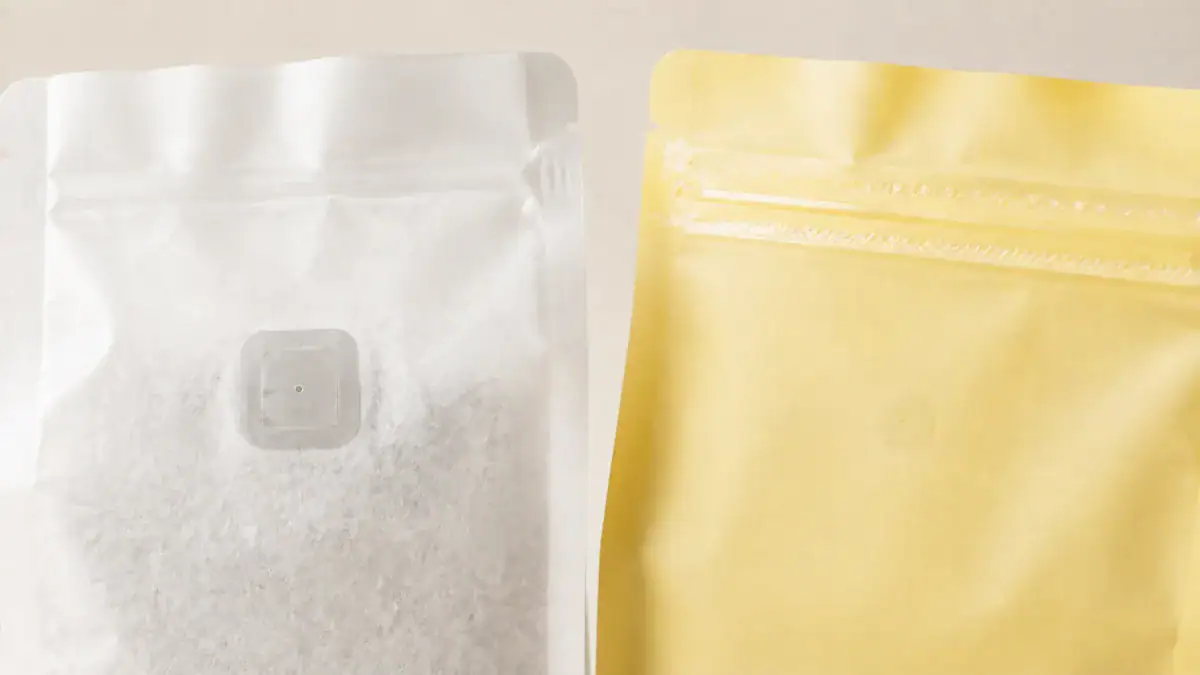
The flat degassing valve — flush with the film, far less plastic than the classic moulded cap.
We already carry lines fitted with flat valves — alongside the classic Wicovalve, which remains the reliability benchmark for one-way degassing. If you want to see and squeeze the difference yourself, ask for both in a sample pack.
Less plastic per bag, flush surfaces for print, neater stacking and shipping — the flat valve is the rare upgrade that improves the look, the logistics and the footprint at the same time.
// Trend 04
Recycled content moves from pledge to specification
For years, “made with recycled content” was a marketing line. PPWR turns it into a legal requirement, with minimum post-consumer recycled (PCR) content targets for plastic packaging phasing in from 2030. The roasters who move early get the story and skip the scramble.
PCR bags keep the recyclable mono-PE construction and add a post-consumer recycled core — same bag on the shelf, materially better footprint on paper and in fact. If you’re curious how recycled content is actually accounted for, our explainer on the mass balance approach in PCR packaging goes deeper.
// Trend 05
Lightweighting: record coffee prices meet right-sized packaging
Green coffee hit record prices in 2025 and has stayed volatile since — and when the beans cost that much, nobody wants to overspend on the bag around them. The industry’s response is lightweighting: thinner high-performance films, flatter components (see trend 03), and right-sized packs with less empty headspace — which PPWR’s rules on excessive packaging push in the same direction anyway.
Cost pressure is also changing how roasters buy. Tying cash up in a 20,000-unit custom order is a harder sell when green prices swing month to month — which is why stocked bags, ordered a carton at a time as you need them, keep gaining ground as the working capital–friendly option.
// Trend 06
Honest labels: QR codes in, vague green claims out
“Eco-friendly” with no evidence is now a liability — EU rules on green claims are tightening, and customers have learned to look for the certificate behind the adjective. The 2026 label is specific: a named certification (OK compost HOME, EN 13432, cyclos-HTP), a one-line disposal instruction, and increasingly a QR code linking to origin and end-of-life information.
The same honesty is settling the compostables question. Certified home-compostable bags — a range we’ve run since 2014 — are thriving in the channels where composting really happens: farm shops, organic retail, zero-waste stores. What’s disappearing is compostable-as-vague-virtue; what’s growing is compostable-with-a-logo-and-an-instruction.
// Trend 07
Small batches, fast turnarounds
Specialty coffee runs on limited releases — a single-lot Gesha doesn’t wait twelve weeks for custom bags. So 2026’s working setup is a two-track system: stocked bags with labels or sleeves for speed and small lots, and full custom print for the core range where volume justifies it.
It’s the same logic as trend 05, applied to branding: commit slowly, iterate quickly. Stocked stand-up pouches and box bottom bags ship next working day from our EU warehouse from a single carton — test a design, a size or a material on real customers, then take the winner to custom print.
// FAQ
Frequently asked questions
What is the biggest coffee packaging trend in 2026?
Regulation-driven recyclability. With the EU’s PPWR in force since 12 August 2026, the shift to mono-material recyclable structures — single-plastic PE bags and paper-stream bags — has gone from a marketing choice to the industry default.
What is a flat degassing valve?
A low-profile, round one-way valve applied almost flush with the bag film, doing the same job as the classic moulded cap valve — venting CO₂ from fresh-roasted coffee while keeping oxygen out — with a lot less plastic. Increasingly common on bags in Japan and Europe, and available on our stocked lines today.
What does PPWR mean for coffee roasters?
Since 12 August 2026 the EU Packaging and Packaging Waste Regulation has been in force, with packaging required to be designed for recycling by 2030 and minimum recycled-content targets for plastics phasing in. Practically: choose recyclable structures now and keep the certificates on file.
Are compostable coffee bags still relevant in 2026?
Yes — in the right channel. Certified home-compostable bags (OK compost HOME) work where customers actually compost: farm shops, organic and zero-waste retail. What’s fading is the uncertified “eco” claim; what’s growing is certified compostable with a clear disposal instruction on the bag.
How can roasters keep packaging costs down while coffee prices are high?
Buy stocked bags by the carton instead of tying cash up in large custom runs, right-size the bag to the coffee weight, and use labels or sleeves on stock bags for limited releases. Move to custom print only for the core range where the volume clearly justifies it.
Packaging that’s ready for what’s next
Mono-material recyclable, certified home-compostable and PCR bags — with flat-valve lines in stock — shipped next working day from our EU warehouse, from a single carton.
Shop recyclable bags Shop compostable bags Request free samples