 UK
UK EU
EU AU
AU UAE
UAE
Blog
PPWR Explained: What the EU Packaging Regulation Means for Coffee Roasters
// Guide · PPWR · EU Packaging Rules
Since 12 August 2026, the EU Packaging & Packaging Waste Regulation (the PPWR) has applied in every member state. It is the biggest change to European packaging law in thirty years, and if you sell coffee (or any packaged food) in the EU, your bags are squarely in scope.
This guide cuts the 200-page regulation down to what a roaster actually needs to know: what already applies, what lands in 2028 and 2030, which bag materials are exposed, and the questions to put to your packaging supplier now.
// The Basics
What is the PPWR?
The Packaging and Packaging Waste Regulation (EU) 2025/40 replaces the 1994 Packaging Waste Directive. That word swap matters: a directive had to be translated into 27 different national laws; a regulation applies identically in every member state, no local transposition. One rulebook from Lisbon to Helsinki.
It entered into force on 11 February 2025 and has applied since 12 August 2026. The goals are blunt: all packaging recyclable by 2030, less packaging overall, minimum recycled content in plastics, and harmonised labels so consumers finally know which bin.
If you place packaged coffee on the EU market, whether you roast in Berlin or ship into Rotterdam from outside the EU, the PPWR reaches you. Mostly it reaches you through your packaging, which is why the practical work starts with your supplier.
// Timeline
The dates that matter
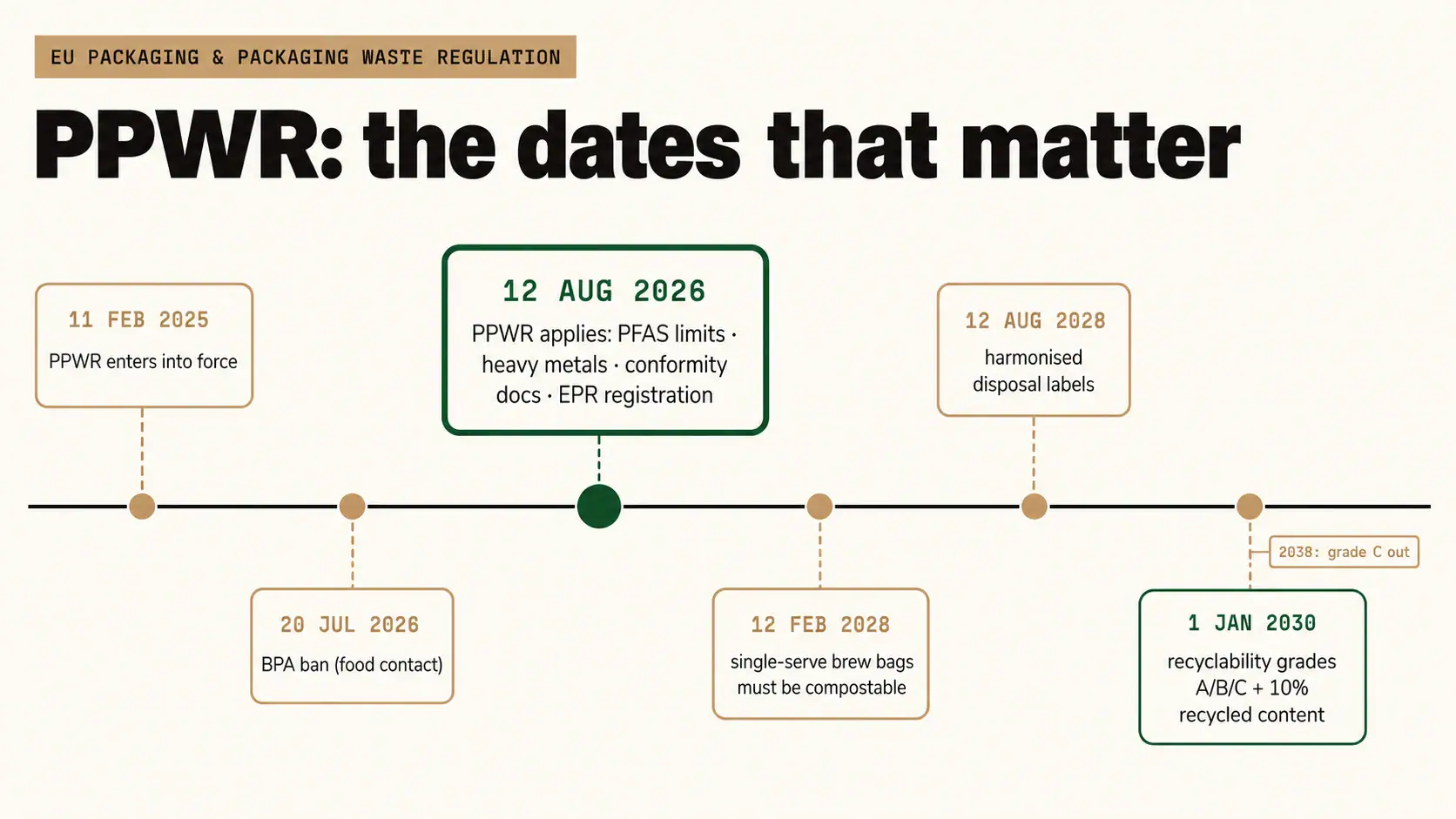
| Date | What happens |
|---|---|
| 20 Jul 2026 | The BPA ban in food-contact materials took effect. It is a separate regulation, (EU) 2024/3190, but it landed the same summer; inks, lacquers and adhesives are the usual risk points. |
| 12 Aug 2026 | PPWR applies. PFAS limits in food-contact packaging (≤25 ppb per targeted substance, ≤250 ppb targeted sum, ≤50 ppm total fluorine). Heavy metals (Pb + Cd + Hg + CrⅮ) capped at 100 ppm. Packaging manufacturers must draw up an EU Declaration of Conformity and technical documentation for their packaging. Producers must be registered for EPR in each member state where they sell. |
| 12 Feb 2028 | Permeable tea and coffee bags and soft single-serve units that are thrown away with the product (the brew-in formats such as drip filters and pads, not your retail pouches), plus fruit & veg stickers, must be industrially compostable. |
| 2028 or later | Harmonised labelling. Packaging must carry the new EU material-composition label 24 months after the Commission adopts the label design. That decision was due in August 2026 and had not been published by September 2026, so 2028 is the earliest date, not a fixed one. Expect artwork changes either way. |
| 1 Jan 2030 | Design-for-recycling grades. Packaging must be recyclable to grade A, B or C (at least 70% recyclable by weight) to stay on the market. Recycled-content minimums for plastic packaging start too: 10% for contact-sensitive packaging made from plastics other than PET, which covers most coffee and food pouches. Packaging weight and volume must also be cut to the minimum the product needs. The Commission is still finalising the detailed grading and recycled-content calculation rules. |
| 1 Jan 2038 | Grade C is phased out: only grade A and B packaging can be placed on the market. |
The pattern: 2026 is about paperwork and chemistry, 2028 onwards about labels, 2030 about materials. The mistake is treating 2030 as far away: a brand that reprints custom packaging every 18–24 months has maybe two artwork cycles left to get there.
// Your Bags
What this means for coffee bags, honestly
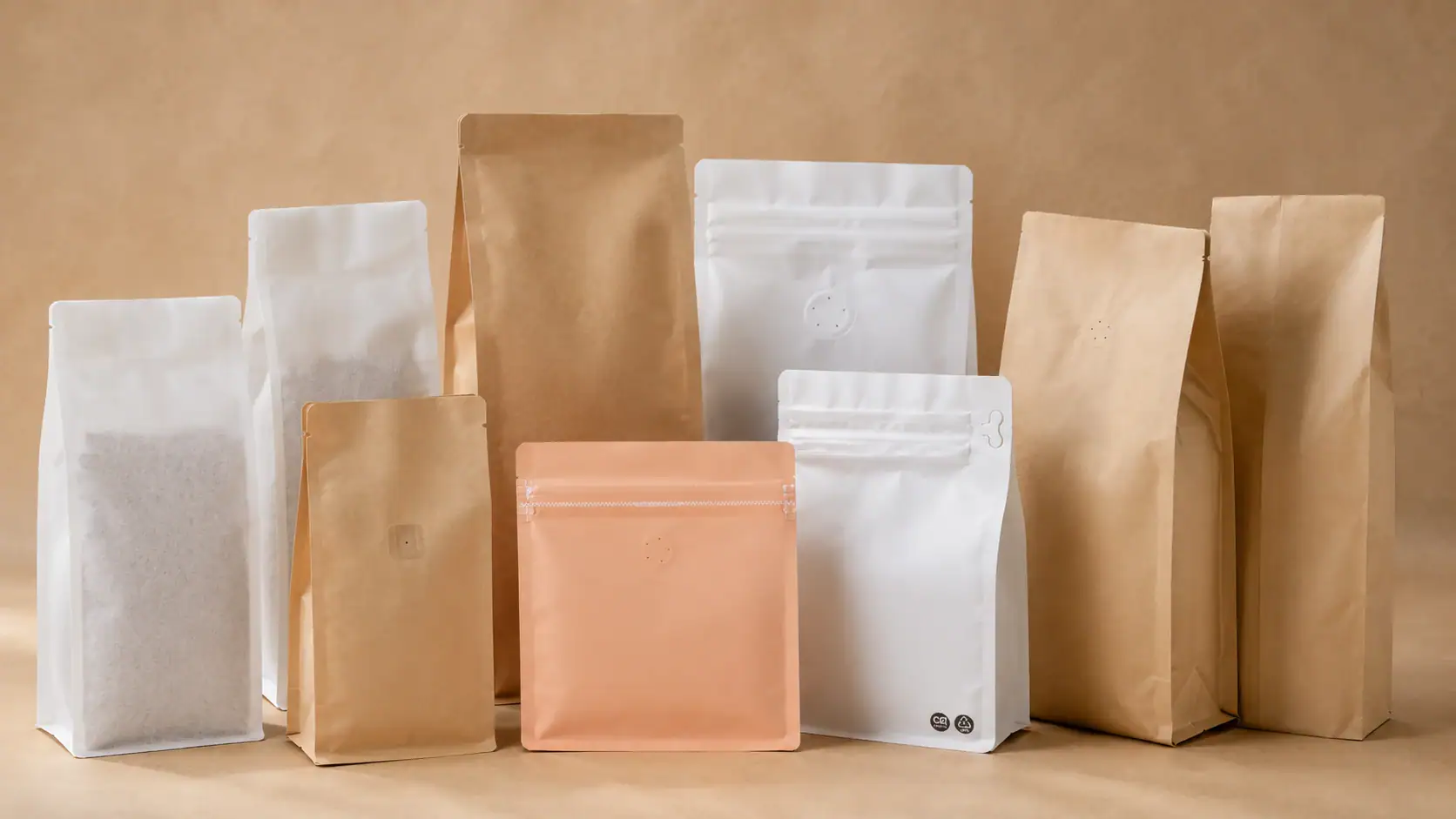
Most coffee bags on the market today, including most of ours, are conventional multi-material laminates: kraft paper or PET bonded to metallised film and polyethylene. They give outstanding barrier and shelf life. They are also exactly the structures the 2030 design-for-recycling grades put under pressure, because multi-material laminates are hard to recycle.
- Nothing was banned on 12 August 2026. Kraft and foil laminates stay legal. What changed is the chemistry and paperwork behind them: PFAS and heavy-metal limits, and a Declaration of Conformity from the packaging manufacturer.
- The 2030 grading is the real deadline for materials. Mono-material films (one plastic, one recycling stream) and paper-based structures are built for it. Multi-layer kraft/metallised laminates and aluminium foil are the exposed ones.
- Recycled content lands the same day. From 2030, contact-sensitive plastic packaging (which food pouches are) needs a minimum 10% recycled content. PCR films answer this directly.

If your bag is one material (mono-PE, paper-stream) or certified compostable, you’re pointed the right way for 2030. If it’s a kraft or foil laminate, plan the switch across your next one or two artwork cycles. Don’t wait for 2029.
// Ready Now
The PPWR-ready materials, stocked in the EU
We introduced compostable coffee bags in 2014 and launched a mono-material recyclable bag globally in 2019, so the ranges the PPWR points towards aren’t a pilot programme for us; they’re on the shelf in our Netherlands warehouse.
| Range | Structure | End of life | Certification |
|---|---|---|---|
| Recyclable mono-PE | Single-stream PE with EVOH barrier | Kerbside recyclable | cyclos-HTP assessed |
| Mono-PE + PCR | Recyclable PE with post-consumer recycled content | Kerbside recyclable | Meets the 2030 recycled-content direction |
| Paper stream | Kraft paper with barrier coating | Recyclable with paper | FSC® / PEFC sourced paper |
| Compostable | Kraft / NKME and PLA-based films | Home & industrial compost | EN 13432 · OK Compost HOME (TÜV Austria) · Seedling |
Barrier is the honest trade-off: a mono-PE or compostable film gives good protection, though not foil-level protection. For most roasted coffee with sensible stock rotation, good is enough. Compare every film in our materials guide.
// Action Plan
Five things to do now
- Audit what you use. List every pack format you sell in the EU and what it’s made of. If you don’t know the film structure of your own bags, that’s the first email to send.
- Ask your supplier the hard questions. Can they state their PFAS position for each food-contact film? Heavy-metals compliance? Will a Declaration of Conformity come with your packaging? A supplier who can’t answer in writing is a supplier betting your compliance.
- Check who registers for EPR. If you place packaged coffee on the market in several member states, confirm your producer-responsibility registrations country by country. The obligation sits with you, not your bag supplier.
- Map your 2030 switch now. If you’re on kraft or foil laminate, decide which artwork cycle moves you to mono-PE, paper-stream or compostable, and test the film with your coffee before you commit a print run.
- Use stock bags to de-risk the transition. This is the quiet advantage: our PPWR-ready ranges are stocked and sold from a single carton, so you can switch material and validate it with real customers without committing to 2,000 printed units of the wrong film.
// FAQ
Frequently asked questions
What is the PPWR in simple terms?
The Packaging and Packaging Waste Regulation (EU) 2025/40 is the EU’s new packaging law, which has applied since 12 August 2026. It sets chemical limits (PFAS, heavy metals), requires conformity paperwork for packaging, brings in harmonised material labels once the Commission adopts the label design (2028 at the earliest), and requires all packaging to be recyclable to a graded standard by 2030.
Does the PPWR ban kraft or foil coffee bags?
No. Nothing was banned in 2026. But from 2030, packaging must reach design-for-recycling grade A, B or C (at least 70% recyclable by weight) to stay on the EU market, which puts conventional multi-material kraft and foil laminates under pressure. Grade C is then phased out by 2038.
Does the PPWR affect small roasters?
Yes. If you place packaged coffee on the EU market you’re in scope, whatever your size, chiefly through extended producer responsibility registration and the compliance of the packaging you buy. In practice, most of the technical burden is carried by your packaging supplier; your job is to buy from one who can evidence it.
Are compostable coffee bags still allowed under the PPWR?
Yes. Certified compostable packaging (EN 13432, OK Compost) remains a valid route. The PPWR goes further for one niche: permeable tea and coffee bags and soft single-serve units (the brew-in formats, not retail pouches) must be industrially compostable from 12 February 2028.
I’m outside the EU but sell into it. Does the PPWR apply to me?
Yes. The PPWR applies to all packaging placed on the EU market regardless of where the product was made or roasted. UK, Swiss and other non-EU brands shipping into the EU need compliant packaging and the paperwork behind it.
What should I ask my packaging supplier about the PPWR?
Four things: their PFAS position for every food-contact film; heavy-metals compliance; whether a Declaration of Conformity accompanies your packaging; and which of their ranges already meet the 2030 design-for-recycling direction. We’re mapping every structure we stock against these requirements, so ask us.
Get PPWR-ready without a print run.
Recyclable mono-PE, paper-stream and certified compostable bags, stocked in our Netherlands warehouse, sold from a single carton, dispatched the next working day.
Shop recyclable bags Compare materials Get a custom quote