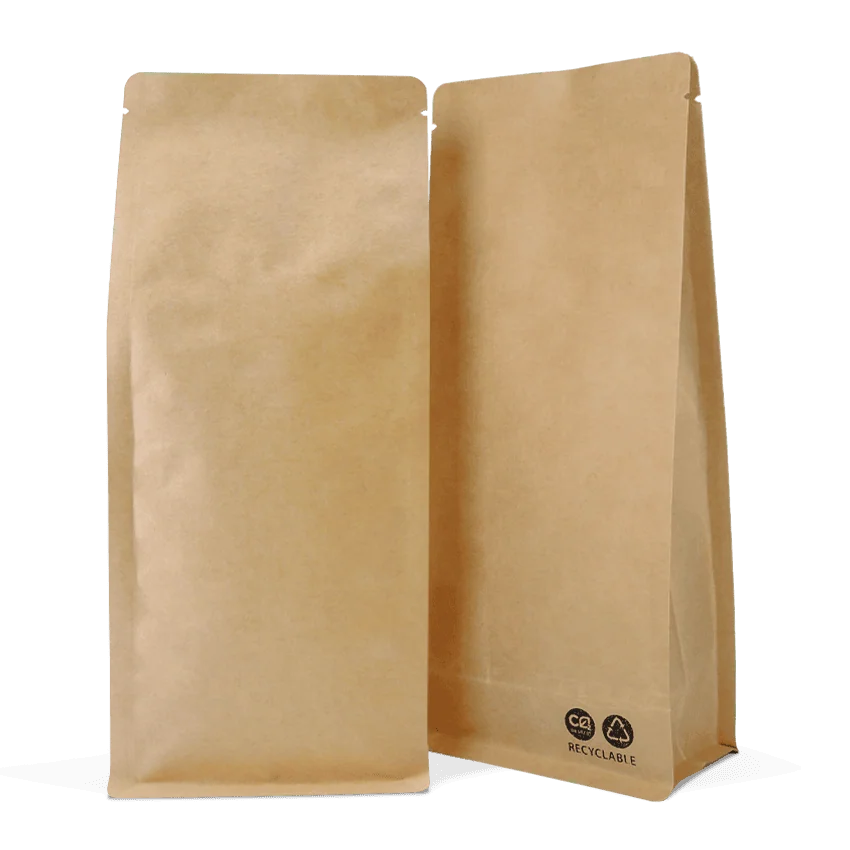
Our team has done the hard work so you don’t have to. Every laminate we stock or custom-print falls into one of six families — compare them side by side below, then jump straight to the bags made from the one that fits. All our packaging is produced under BRCGS food-safety certification.
Longest protection; the classic three-layer coffee bag
* Degassing valves are industrially compostable only — remove before home composting. † Dispose of with general waste. ‡ Typical guidance for roasted coffee in an unopened bag with a one-way valve, stored cool and dry — actual shelf life depends on your product and filling process. Certifications available on request — contact our team.
// Quick Answer
Start from what matters most to you
Greenest end of life
Compostable NKME
Breaks down into CO₂ and water — no microplastics. Composts in under 90 days in commercial facilities.
Composite materials of two or more substrates bonded together to improve strength and barrier properties.
Compostable NKME (cellulose film)
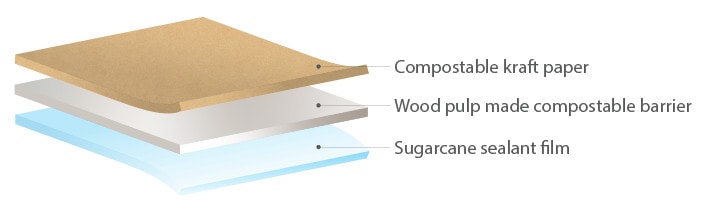
A cellulose-based film made from renewable wood pulp grown in managed plantations, paired with natural or white kraft outer layers. Known for an excellent barrier against gases, oils and aromas — ideal for keeping coffee and food fresh. Certified EN 13432 industrially compostable; the individual layers are certified for home composting in 90 days.
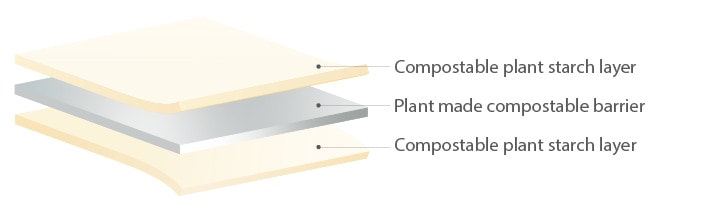
A bioplastic derived from renewable resources such as corn starch, sugarcane or cassava. Good barrier properties — slightly more permeable to moisture and gases than NKME — with excellent printability, making it one of the best options for custom-printed compostable packaging. Industrially compostable (EN 13432).
Two layers of LDPE with a high EVOH barrier to maintain freshness — plus an LDPE one-way valve and LDPE zipper, so the whole bag — valve and zip included — is recyclable in the PE film (level 4) stream where collection exists. Matt finish, with clear-window options. Certified by cyclos-HTP, the institute for recyclability and product responsibility.
FSC-certified paper with advanced barrier properties — the easiest recycling route for your customers, straight into the kerbside paper stream. Available with a flat degassing valve for coffee; simply remove the valve before disposal for complete recyclability.
The same mono-PE construction as our recyclable range — high EVOH barrier, matt finish, cyclos-HTP certified and recyclable in the PE film (level 4) stream where collection exists — but with a post-consumer recycled core: plastic that has already lived one life as packaging. Cuts virgin plastic use and supports recycled-content targets under PPWR and plastic packaging tax planning.
Custom projects open up further structures — including BioPE and specialty surface papers such as rice and cotton paper — and any of the laminates below in white, natural or black kraft. If you have a spec in mind, we’ll match a structure to it.
Three-layer laminates with excellent barrier properties — the proven workhorses of coffee and food packaging, used across our stock range and available for any custom print.
Construction
Layers
MOPP / AL / LLDPE
Matte oriented polypropylene · aluminium barrier · linear low-density polyethylene
Matte oriented polypropylene · metallized PET · LLDPE
MOPP / PET / PE
Matte oriented polypropylene · PET · polyethylene
PET / VMPET / LLDPE
PET · metallized PET · LLDPE
Paper / VMPET / LLDPE
Kraft paper (white, natural or black) · metallized PET · LLDPE
Paper / MCC-PET / LLDPE
Kraft paper (white, natural or black) · ceramic-coated PET (non-metallic) · LLDPE
Paper / PET / LLDPE
Kraft paper (white, natural or black) · PET · LLDPE
PET / LLDPE
PET · LLDPE
Each structure reads surface · barrier · heat-seal layer. Surface papers: white, natural or black kraft as standard; rice, cotton and other specialty papers available on custom projects. Multi-material laminates are not recyclable. If end-of-life matters to your brand, compare the eco-friendly families above — or ask our team which barrier your product actually needs.
// PPWR · Applies From 12 August 2026
Choosing a material is now a compliance decision too
The EU Packaging & Packaging Waste Regulation sets recyclability and recycled-content requirements for packaging sold in the EU. Our recyclable, compostable and PCR ranges are built with this in mind.
From 27 September 2026, EU rules require environmental claims on packaging to be backed by recognised certification. Our materials carry the certificates that substantiate yours:
Compostable NKME & PLA
“Compostable under industrial conditions” — certified EN 13432 (Seedling); NKME layers additionally certified OK Compost HOME.
Recyclable PE & PCR
Recyclability certified by cyclos-HTP; PCR supports substantiated recycled-content claims.
Barrier paper
Made with FSC-certified paper, recyclable in the paper stream.
Certificates supplied on request. Claim rules vary by market and change over time — always confirm final on-pack wording with your own advisors.
// Which Bin?
Help your customers dispose of it right
Around a third of consumers put compostable packaging in the recycling bin. Print the right disposal guidance on your bag — here’s the answer per material.
Compostable
Compost / food waste
Food-waste stream or compost heap. Remove the valve before home composting — valves are industrial-only. Never the recycling bin.
Recyclable PE & PCR
PE film collection
Level 4 PE / soft-plastics collection, bag, valve and zip together — where the stream exists locally.
Barrier paper
Paper bin
Straight into kerbside paper recycling — just remove the flat valve first.
Foil & ceramic barrier
General waste
Multi-material laminates can’t be recycled — general waste, not the recycling bin.
// FAQ
Material questions, answered
Can compostable bags go in the recycling bin?
No — compostable materials are designed to break down through composting, not recycling. Placing them in a recycling bin can contaminate the recycling stream. Dispose of them in a composting bin or via the food-waste stream where it exists.
What is EN 13432?
EN 13432 is the EU standard for compostability. Certified materials must biodegrade into CO₂, disintegrate within 12 weeks, fully degrade within 6 months, and leave compost that is safe for growing food. All laminates in our compostable bags are, as a minimum, certified EN 13432 industrially compostable.
What’s the difference between home and industrial composting?
Industrial facilities control temperature and conditions, so materials break down faster and more reliably. Home composting runs cooler and slower. Our NKME layers are certified for home composting in 90 days; PLA needs the higher temperatures of an industrial facility. Valves are industrially compostable only — remove them before home composting.
Do compostable materials leave microplastics behind?
No. When properly composted, they degrade into CO₂ and water only, leaving no microplastics behind.
Will compostable bags degrade on the shelf?
No. Industrially compostable materials only degrade under specific compost conditions — in nearly all other situations, including storage and retail shelves, they will not break down.
How do I make my recyclable PE bag fully recyclable?
You don’t need to do anything — the bag, one-way valve and zipper are all LDPE, so the whole bag goes into the PE film (level 4) collection as-is, wherever that stream exists. For barrier paper bags, just remove the flat valve before putting the bag in the paper bin.
Still not sure? Feel the difference yourself.
Order a free sample pack and compare the materials in your hands — real bags, real films, delivered to your business. Or talk to our team about which barrier your product actually needs.
 UK
UK EU
EU AU
AU UAE
UAE