How to recycle different types of coffee packaging

// Guide · Recycling & Sustainability

The same coffee bag can belong in Germany’s Gelber Sack, France’s yellow bin, the Dutch PMD bag — or, if it’s the wrong material, in no recycling stream at all. Europe sorts its packaging in a dozen different ways, but one rule holds everywhere: what your coffee packaging is made of decides where it goes.

This guide covers every common type — recyclable mono-material bags, compostable bags, kraft and foil laminates, capsules and the grounds themselves — with country-by-country sorting rules for Germany, France, the Netherlands, Belgium, Italy and Spain, plus what the EU’s new packaging regulation changes from August 2026.

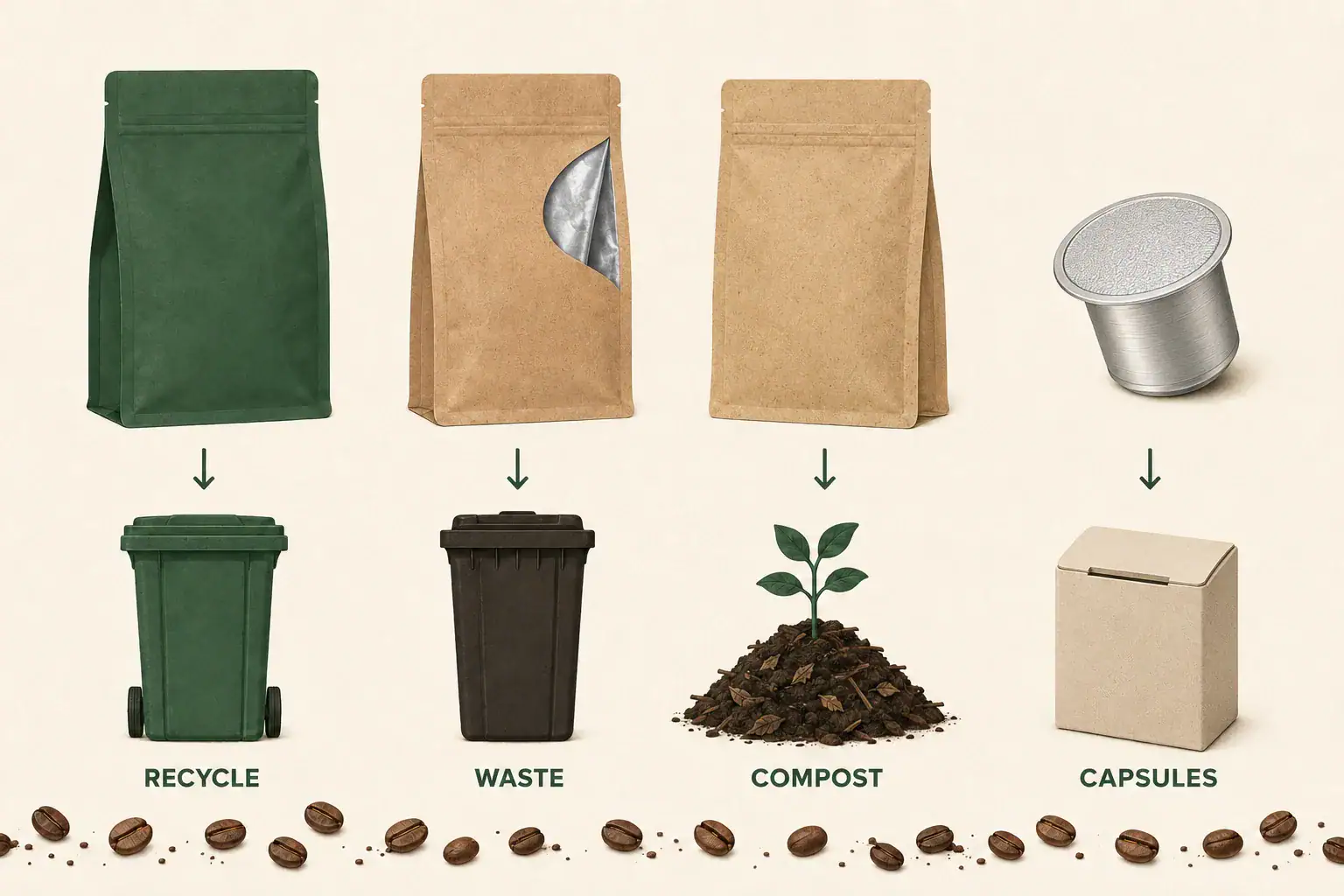
Four types of coffee packaging and where each goes: recycling, general waste, compost and capsule collection

// The Problem

Why coffee bags are harder to recycle than they look

Coffee is a demanding product to package. Oxygen, light and moisture all stale roasted beans, so most traditional coffee bags are laminates — several thin layers of different materials (paper, plastic, aluminium) bonded together for barrier strength. That’s brilliant for freshness and useless for recycling, because the layers can’t be separated at a sorting facility.

  • Looks can deceive. A bag that looks like kraft paper usually has a plastic or foil layer inside. If it’s a laminate, it won’t be recycled — even where it’s collected.
  • One material, one rule. Mono-material bags (a single plastic such as polyethylene) recycle cleanly, because there’s nothing to separate — and most EU countries already collect them with household packaging.
  • Compostable is not recyclable. Compostable bags go to compost, never in the packaging or plastics bin, where they’re a contaminant.

So the process is always the same three steps: identify the material → empty the bag properly → use your country’s stream. Here’s the quick reference, then the country rules.

// Quick Reference

Where does your coffee packaging go?

Packaging type How to spot it General rule
Recyclable mono-PE bagSingle soft plastic; often labelled “recyclable” / PE 4Household packaging collection (yellow bin/bag, PMD) in most countries
Paper-stream recyclable bagCertified paper-based structure, labelled for paper recyclingPaper collection
Compostable bag (NKME/PLA)Certification logo, e.g. OK compost HOME / Seedling (EN 13432)Home compost if home-certified; bio bin only where your country allows it
Kraft-look laminatePaper outside, plastic or foil shine insideFollow local rules — collected in some countries, but not recycled
High-barrier foil laminateMetallic inside, crinkles and holds its shapeSame as kraft laminate — check locally; often residual waste
Coffee capsulesAluminium or plastic podsPackaging bin in DE/FR; brand take-back or collection points elsewhere
Used coffee groundsBio bin / organic waste — separate bio-waste collection is now EU-wide

Whatever the material, empty the bag first — tip out every last ground and give it a shake. Leftover coffee is the most common reason packaging gets rejected as contaminated.

Infographic showing where each type of coffee packaging goes: mono-PE to packaging collection, compostable to home compost, laminates to residual waste, grounds to bio bin

// Country by Country

Recyclable coffee bags across Europe: the country rules

Here’s the good news for mono-material PE bags: unlike the UK, most EU countries already collect flexible plastics with household packaging. We launched a mono-material recyclable coffee bag globally in 2019 — here’s where it goes in the main markets:

Cross-section comparing a multi-layer laminate coffee bag with a recyclable mono-material coffee bag
Country Where the bag goes Worth knowing
GermanyGelber Sack / Gelbe TonneTakes all lightweight packaging — plastic, metal and composites. Sorting happens downstream, so only mono-materials actually get recycled.
FranceYellow bin (bac jaune)Since 2023 all packaging goes in the yellow bin nationwide. The Triman + Info-tri label on the pack confirms the sorting instruction.
NetherlandsPMD bag / containerFlexible plastic packaging is accepted — but plastic-aluminium laminate pouches are the stated exception (residual waste). Some municipalities post-separate from general waste.
BelgiumBlue Bag (PMD)The “New Blue Bag” has taken flexible plastics since 2021 — coffee bags go in with wrappers and film.
ItalyPlastica collectionPlastic packaging, including film, goes in the plastics collection (Corepla system); check your comune for local colour coding.
SpainYellow container (contenedor amarillo)Plastic packaging including bags and film goes in the yellow container.

One caveat everywhere: municipalities can vary within a country, so when in doubt, your local waste authority’s website has the final word. But the pattern is consistent — a mono-material bag has a real recycling route in every major EU market today.

// Compostable Bags

Compostable coffee bags: getting disposal right

Compostable films such as PLA (made from plant starches) and kraft-based compostable structures are a genuinely low-impact choice — we introduced compostable coffee bags in 2014. But “compostable” only delivers if the bag ends up in the right place, and the right place differs by country.

Compostable coffee bag disposal: home compost yes, recycling bin never
  1. Never in the packaging or plastics bin. Compostable plastics are a contaminant in plastic recycling — in every country.
  2. Check the certification, not the word. A bag certified home compostable (TÜV Austria’s OK compost HOME) can go in your garden compost anywhere. The Seedling / EN 13432 mark alone means industrially compostable — it needs the sustained 55–60°C of a commercial facility.
  3. Bio bin rules vary by country. Italy accepts certified compostable packaging in the organico (it’s built into the Biorepack system). Germany largely keeps packaging out of the Biotonne. Elsewhere, check your municipality before using the bio bin — home compost is the route that works everywhere for home-certified bags.
Rule of thumb

Look for the logo. OK compost HOME = your compost at home, any country. Seedling / EN 13432 only = industrial composting, where your bio collection accepts it. No certification logo at all? Treat the “compostable” claim with caution.

// Everything Else

Laminates, capsules and the grounds themselves

Kraft and foil laminate bags

The classic high-barrier coffee bag — kraft paper or matte film outside, plastic and/or aluminium inside — is a multi-layer laminate whose layers can’t be separated. Here’s the European subtlety: in Germany and France these bags still belong in the yellow bag or bin, because those systems collect all packaging and sort downstream — but as laminates they’re sorted out and burned for energy, not recycled. In the Netherlands they go straight in residual waste. Collected is not the same as recycled: if you want the bag to have a second life, it has to be a mono-material or paper-stream structure to begin with.

Coffee capsules

Rules vary: in Germany, aluminium capsules go in the Gelber Sack with their grounds still inside — separation happens industrially. In France, capsules have gone in the yellow bin since 2023. In Italy, Nespresso and the aluminium consortium CIAL run collection points, and Milan started accepting aluminium capsules in its yellow bag in 2026. Elsewhere, use the brand’s take-back scheme. The EU’s new packaging rules push capsules into separate collection everywhere from August 2026.

Used coffee grounds

The easiest win of all. Grounds are nitrogen-rich and belong in the bio bin or your compost — and separate bio-waste collection is now required across the EU, so every household has a route for them.

// What’s Changing

The PPWR: Europe’s packaging rules step up in August 2026

The EU’s Packaging and Packaging Waste Regulation (PPWR) entered into force in February 2025 and applies from 12 August 2026. For coffee packaging it means:

  • All packaging must be designed for recycling by 2030, with recyclability graded and poor grades phased out — a countdown for unrecyclable laminates.
  • Harmonised sorting labels are coming EU-wide, so the same bag will carry the same disposal instruction in every member state — the end of guessing between yellow bins, PMD bags and plastica.
  • Producer fees (EPR) scale with recyclability — recyclable and compostable packaging becomes progressively cheaper to put on the market than laminates.

The direction of travel is the same as the sorting rules above: single-material packaging wins, everywhere. Which brings us to the roasters.

// For Roasters

Roasters: one bag, many countries — design for the strictest bin

If you sell across borders — and most European roasters do — your bag meets six different sorting systems. Three ways to make that work for you instead of against you:

  • Pick a single-stream material. A mono-PE recyclable bag has a household route in every major EU market; paper-stream recyclable uses the most universal bin of all; certified home-compostable bags work in any garden. All three also position you ahead of PPWR recyclability grading and EPR fee scaling.
  • Print the disposal instruction on the bag. France already requires Triman + Info-tri; harmonised EU labels are coming. A clear one-liner per market removes the guesswork that sends good packaging to the incinerator — and certification logos (OK compost HOME, Seedling, cyclos-HTP) carry weight with customers.
  • Match barrier to your shelf-life needs. Recyclable and compostable films offer good barrier — enough for most specialty coffee sold fresh. If you genuinely need the highest barrier, that’s what foil laminates are for; just be honest on the label. Compare structures in our materials guide.

All our eco ranges are stocked in our EU (Netherlands) warehouse — next-working-day dispatch for orders before 12:00, delivery in 2–5 working days across the EU, from a single carton — so you can test a recyclable or compostable bag on real customers before committing to custom print.

// FAQ

Frequently asked questions

Can coffee bags go in the yellow bin or PMD bag?

In Germany and France, yes — all packaging goes in the yellow bag/bin, though only mono-material bags actually get recycled. In the Netherlands and Belgium, mono-material coffee bags go in PMD, but plastic-aluminium laminate pouches belong in residual waste. In Italy and Spain, plastic coffee bags go in the plastics/yellow collection.

Are kraft paper coffee bags recyclable?

Usually not. Most kraft coffee bags have a plastic or foil barrier layer inside, making them a laminate that can’t be separated for recycling — even where they’re collected with packaging. The exceptions are certified paper-stream recyclable bags, and compostable kraft bags — which go to compost, not recycling.

How do I know if my coffee bag is recyclable?

Check the label first — look for a sorting instruction (like France’s Info-tri) or a PE/4 mark. No label? Check inside: a metallic sheen means a foil laminate (not recyclable); a paper look with a plastic film inner is also a laminate. A uniform, single-plastic bag is most likely mono-material and recyclable in your packaging collection.

Can compostable coffee bags go in the bio bin?

It depends on the country. Italy accepts certified compostable packaging in the organic collection; Germany largely doesn’t allow packaging in the Biotonne; elsewhere, check your municipality. Home-certified bags (OK compost HOME) can always go in your own compost — and compostable bags never go in the packaging or plastics bin.

How do I recycle coffee capsules in Europe?

In Germany, aluminium capsules go in the Gelber Sack; in France, in the yellow bin. In Italy, use Nespresso/CIAL collection points (Milan now takes them in the yellow bag). Elsewhere, use the capsule brand’s take-back scheme. From August 2026, EU packaging rules require capsules to be part of separate collection across member states.

What is the PPWR and what changes for coffee packaging?

The Packaging and Packaging Waste Regulation is the EU’s new packaging law, applying from 12 August 2026. All packaging must be designed for recycling by 2030, sorting labels will be harmonised EU-wide, and producer fees will scale with recyclability — making mono-material and compostable coffee bags the safe long-term choice.

Ready to switch to recyclable coffee packaging?

Mono-PE recyclable, home-compostable and paper-stream recyclable bags — in stock in our EU warehouse, next-working-day dispatch, from a single carton, delivered across Europe in 2–5 working days.

Shop recyclable bags Shop compostable bags Get a quote